JSON-LD vs. Microdata vs. RDFa: Which Syntax Should You Choose?
Three syntaxes, one purpose: making your content understandable for search engines. But there are significant differences in implementation, maintenance and Google's preference.
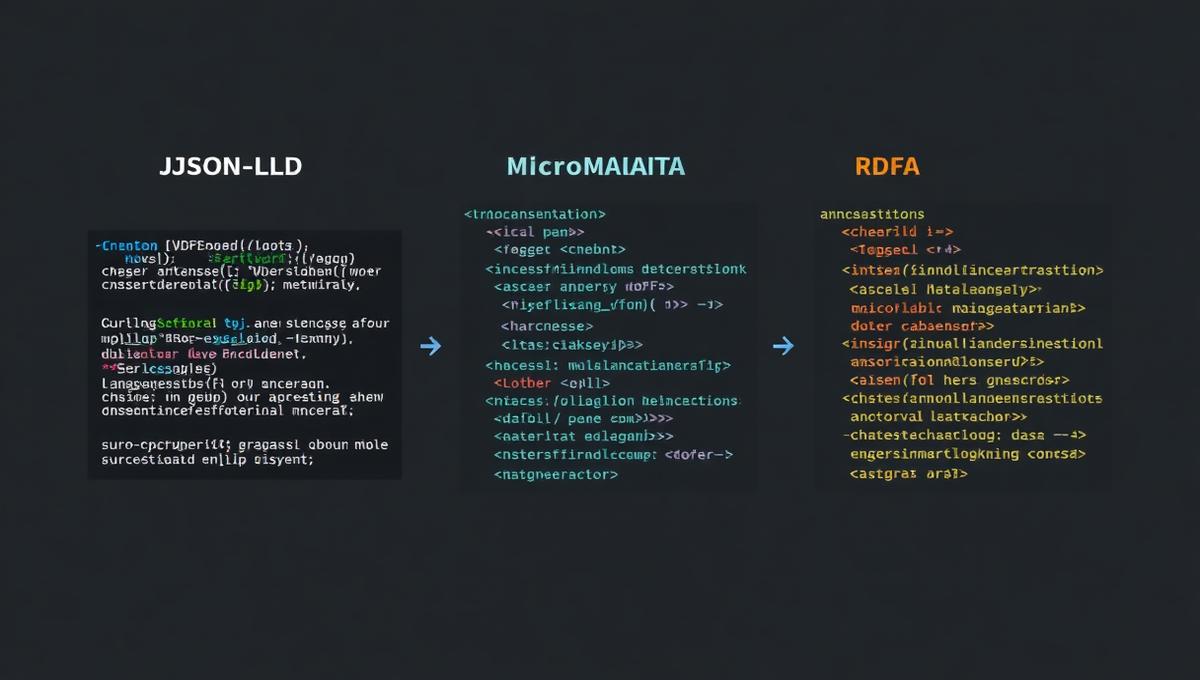
When implementing schema markup, you need to choose between three syntaxes: JSON-LD, Microdata and RDFa. All three can communicate structured data to search engines, but they do it in fundamentally different ways — and Google has a clear favorite.
Google officially recommends JSON-LD as the preferred syntax for structured data. Over 90% of new schema implementations use JSON-LD in 2026 — from FAQ blocks to advanced formats that make content readable for modern AI agents.
JSON-LD
JavaScript Object Notation for Linked Data. Placed as a standalone <script> tag in the page's <head> or <body>, separate from HTML content.
Advantages
Disadvantages
Microdata
HTML attributes (itemscope, itemtype, itemprop) added directly to existing HTML elements.
Advantages
Disadvantages
RDFa
Resource Description Framework in Attributes. Similar to Microdata but based on the RDF standard with attributes like vocab, typeof and property.
Advantages
Disadvantages
Feature comparison
| Feature | JSON-LD | Microdata | RDFa |
|---|---|---|---|
| Google recommended | |||
| Separated from HTML | |||
| Dynamic generation | |||
| Easy maintenance | |||
| Direct content binding | |||
| Multiple vocabularies | |||
| Rich Results support | |||
| Widespread adoption (2026) |
Why Google recommends JSON-LD
Google has explicitly declared JSON-LD as the preferred syntax for several reasons:
- Separation of concerns — JSON-LD separates structured data from HTML, making it easier to maintain both independently.
- Consistency — Since JSON-LD doesn't depend on HTML structure, there's less risk of markup breaking on design changes.
- Scalability — JSON-LD can be automatically generated by schema markup generators without touching the existing website.
- Validation — JSON-LD is easier to test and validate with automated tools.
When to choose what?
- JSON-LD (99% of cases) — Choose JSON-LD as default. It's future-proof, maintainable and has full Google support. Ideal for Rich Results, e-commerce and all other use cases.
- Microdata (legacy) — Only relevant if you already have Microdata implemented and working. Migrate to JSON-LD at next redesign.
- RDFa (niche) — Only relevant for academic or semantic web projects requiring multiple vocabularies.
Ready for JSON-LD?
AI Schema Generator automatically generates optimal JSON-LD markup for your website — with full validation and quality assurance.